
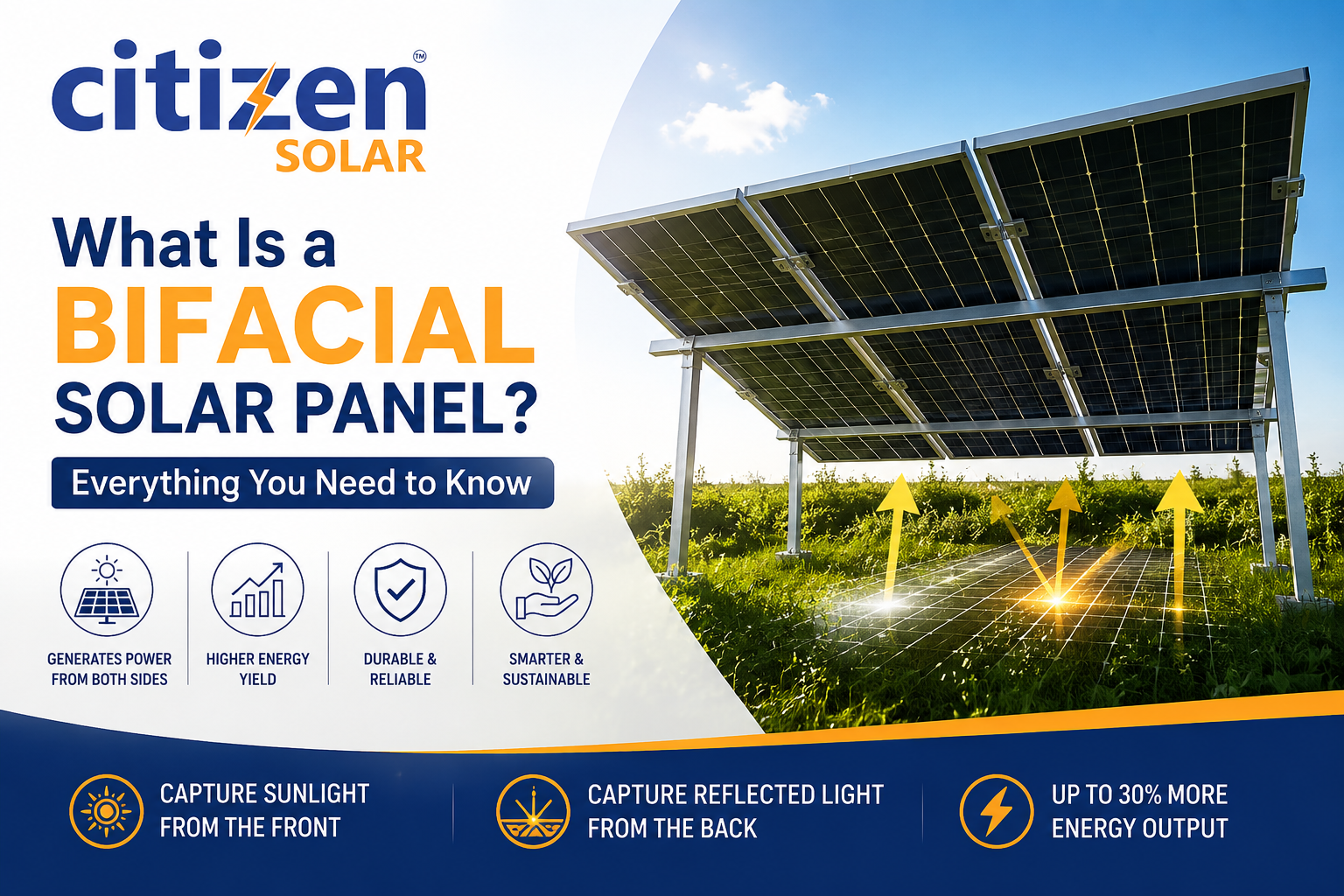
If you’ve been looking into solar options, you’ve probably seen the term “bifacial” a few times. While it sounds technical, the idea is actually pretty simple. A bifacial solar panel collects sunlight from both the front and back. The front takes in direct sunlight like any regular panel, while the back gathers reflected light from the ground, nearby surfaces, or the roof. Because of this, bifacial panels can generate more electricity than standard panels of the same size.
This article explains how these panels work, the types you can choose from, their pros and cons, and helps you decide if they’re a good fit for you.
How do Bifacial Solar Panels Work?
Now that you know what a bifacial solar panel is, let’s see how it works in practice. Unlike traditional panels, bifacial panels don’t have an opaque backsheet. Instead, they use a clear backsheet or a second layer of glass, which lets light reach the back of the solar cells. The cells themselves are made to absorb light from both sides while being strong and durable.
But there’s more nuance to it than just “light hits both sides.” A few environmental factors play a big role in bifacial solar panel efficiency, and they’re worth understanding before you commit to an installation.
Ground Reflectivity
This is often the most important factor. If your panel is above a surface that reflects a lot of light, like white gravel or light-colored concrete, the back side gets a real energy boost. Grass or dark soil doesn’t reflect much, so the benefit is smaller. Panels installed over white membrane roofing perform much better than those over regular asphalt roofing, thanks to their reflectivity.
Tilt Angle and Height
The angle and height of the panel also matter for how much reflected light reaches the back. Panels set higher off the ground with more space underneath usually catch more reflected and scattered light. Steeper tilt angles can help as well; it depends on the location. Because every site is different, installers typically check the area before giving exact performance estimates.
Types of Bifacial Solar Panels
Bifacial panels come in a few common designs, and each has its own pros and cons.
Glass-Glass Bifacial Panels
These panels use tempered glass on both the front and back instead of a regular backsheet. They are more durable, resist moisture better, and usually last longer. However, they are also heavier and cost more at the start.
Glass-Transparent Backsheet Panels
In this type, the front is glass, but the back is a clear polymer backsheet instead of another glass layer. This makes the panel lighter and easier to install, all while still allowing light to pass through.
TOPCon Bifacial Panels
TOPCon stands for Tunnel Oxide Passivated Contact. It’s a cell technology that helps panels turn sunlight into electricity more efficiently. When used in bifacial panels, it often gives some of the best performance available today, especially in low light or when temperatures change.
HJT Bifacial Panels
HJT stands for Heterojunction Technology. It uses two types of silicon layers to reduce energy loss. These panels handle heat better than most others, which is important in places with strong sunlight, such as most of India in the summer.
Applications and Suitability
Bifacial solar panels are great for open, ground-mounted setups, especially over reflective surfaces. They’re also a good choice for large commercial or utility projects where extra energy matters. You’ll find them used in carports, floating solar systems, and raised rooftop installations.
They can be used on home rooftops too, but the benefits are usually lower unless the roof is reflective and there’s space for air to flow beneath it.
Advantages of Bifacial Solar Panels
Before discussing the details, consider the main benefits of bifacial solar panels and the reasons many view them as a worthwhile investment despite the higher initial cost.
Enhanced Energy Efficiency
Since they use both sides, bifacial panels usually produce more energy per square foot than regular panels, especially in open or reflective areas.
Longevity and Durability
Panels with glass on both sides are especially well-suited to withstand weather, moisture, and everyday use. Many companies offer 25- to 30-year warranties, showing their confidence in their quality.
Higher Power Output
Depending on how they’re installed, bifacial panels can make 5% to 30% more energy than similar one-sided panels. The actual number depends heavily on your site, so be cautious about any fixed-percentage claims.
Better Return on Investment
Even though bifacial panels cost more upfront, the additional energy they produce over time can offset the higher cost. In some cases, the total cost of owning them is lower than you might expect.
Lower Degradation
Bifacial panels, especially those using high-efficiency solar panel cell technologies like TOPCon or HJT, tend to degrade more slowly year over year than older panel designs, helping maintain output over the long haul.
Disadvantages of Bifacial Solar Panels
Higher Initial Cost
It’s true that bifacial panels cost more than standard ones. The panels themselves are pricier, and sometimes the mounting hardware needed to get the most out of the back side adds to the cost.
Complex Installation Requirements
To get the most from bifacial panels, installers need to think carefully about how high to mount them, the tilt angle, and what’s underneath. If the setup isn’t planned well, you might not see much extra performance, which could make the extra cost not worth it.
Weight and Handling
Panels with glass on both sides are heavier than regular ones. This can make them harder to move and install and sometimes requires a stronger mounting system.
Bifacial vs Monofacial Solar Panels
Monofacial panels are the traditional single-sided option, typically less expensive and easier to install, especially on standard residential rooftops. Bifacial solar panels cost more but can outperform single-sided panels in suitable conditions.
Neither option is universally better; the choice depends on site conditions, budget, and long-term energy goals. For standard home rooftops with minimal reflective surfaces, monofacial panels may offer better financial value.
Are Bifacial Solar Panels Worth It?
This is the question everyone asks. And the honest answer is: it depends. For large industrial solar panel installations, ground-mounted commercial systems, or sites with reflective ground cover, bifacial technology often pays for itself through extra energy yield.
But the real bifacial solar panel benefits show up most clearly at scale, where small efficiency gains translate into meaningful savings over time. And for smaller residential rooftops with few nearby reflective surfaces, the benefits might not justify the added expense. It’s worth getting a proper site assessment before committing.
Bottom Line
Bifacial solar panels represent a useful step forward in solar technology, especially for larger-scale or commercial applications where site conditions can be optimized. They’re not the right choice for every project, but for the right setup, performance gains can be substantial. As with most solar decisions, understanding your site and consulting experienced solar panel manufacturers makes all the difference.
Are you seeking reliable, high-performing solar solutions?
Citizen Solar Limited is a reliable manufacturing partner with a proven track record in the solar industry. Partner with us to build a sustainable, energy-independent future together, one panel at a time.
As one of the established solar companies in india, we bring years of hands-on manufacturing experience to our engineering standards and quality checks across diverse project types. Get in touch today at +91-8000111222 or visit www.citizensolar.com to explore our range of manufacturing and EPC services.
FAQs
What is a bifacial solar panel?
It’s a solar panel designed to absorb sunlight from both its front and back surfaces, generating additional electricity from reflected light.
How efficient are bifacial solar panels?
Efficiency varies by site conditions, but many bifacial panels outperform standard single-sided panels by a noticeable margin when installed correctly.
Are bifacial solar panels better than monofacial panels?
They can perform better in the right setting, though monofacial panels remain more practical and cost-effective for many standard rooftop installations.
Can bifacial solar panels be installed on rooftops?
Yes, though the performance boost is usually smaller than in ground-mounted or elevated installations unless the roofing surface is reflective.
How much extra power do bifacial solar panels produce?
Estimates typically range from 5% to 30% more output, depending heavily on ground reflectivity, mounting height, and tilt angle.
Do bifacial solar panels work on cloudy days?
Yes, they still generate power from diffused light, though output naturally drops compared to clear, sunny conditions.
Are bifacial solar panels worth the higher cost?
For large-scale or commercial installations, often yes. For smaller residential setups without reflective surroundings, it depends on individual site conditions.
Which industries benefit most from bifacial solar panels?
Utility-scale solar farms, commercial rooftops, carports, and floating solar projects tend to see the most consistent benefits from this technology.