
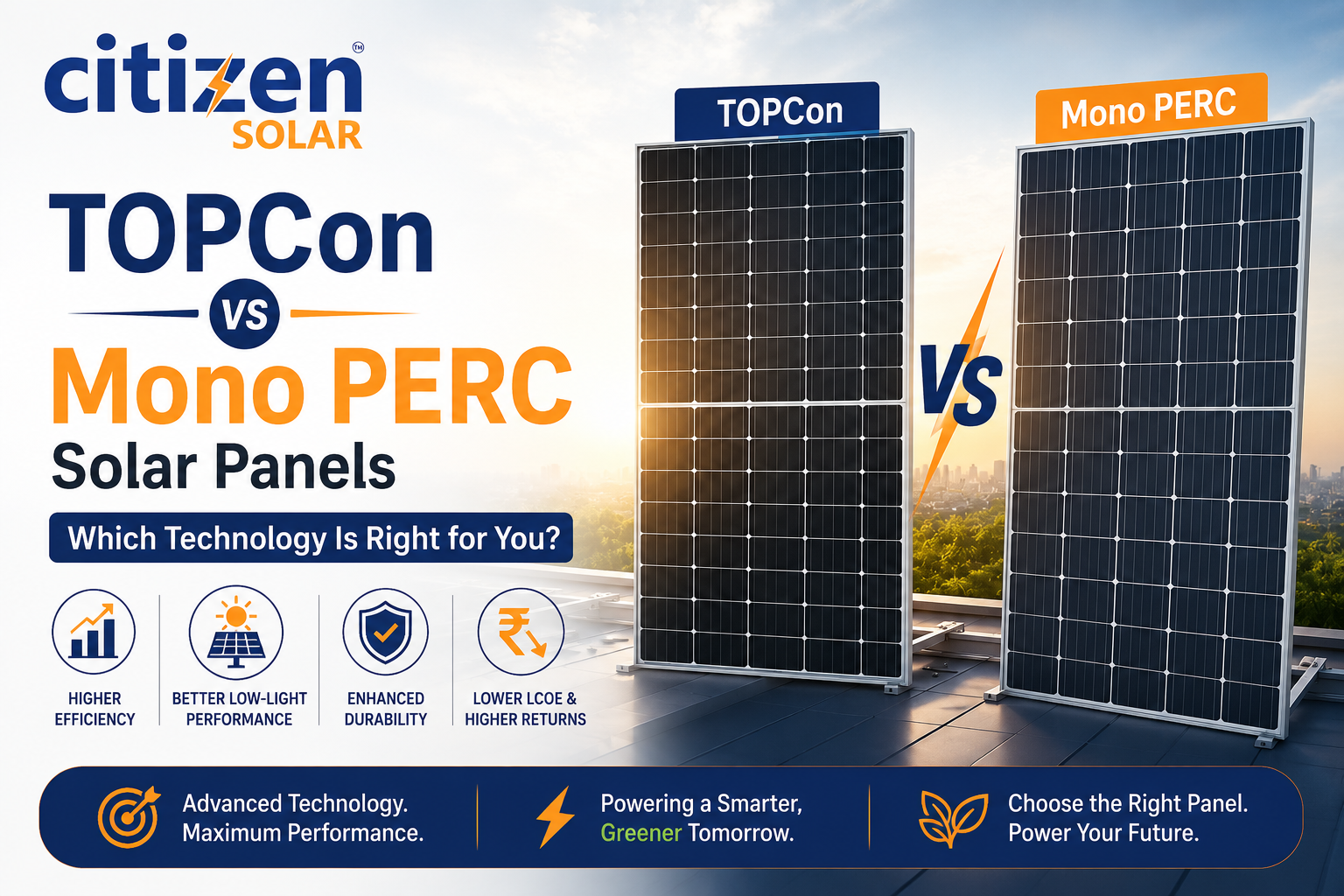
Choosing between panel technologies used to be simple. Not anymore. As solar buyers move beyond the basics, the TOPCon vs. Mono PERC solar panels decision has become one of the most common questions we get from EPC contractors, distributors, and commercial buyers planning large installations in 2026.
Both technologies have their place, and neither is a flat-out “better” choice in every scenario.
This guide breaks down the technical differences, the numbers that actually matter for ROI, and which one fits which kind of project.
Executive Summary for Commercial Solar Buyers
For buyers short on time, here’s the condensed version. TOPCon Solar Panels generally deliver higher efficiency and lower long-term degradation, making them a strong fit for space-constrained or high-yield projects.
Mono PERC Solar Panels, meanwhile, remain a dependable, cost-effective option for large-scale deployments where per-watt budget matters more than squeezing out the last percentage point of output.
The table below lays out the core parameters side by side.
| Parameter | Mono PERC Solar Panels | TOPCon Solar Panels |
| Best Use | Large-scale ground-mount, budget-sensitive projects | High-yield commercial, space-constrained rooftops |
| 25-Year Performance | Strong, slightly higher degradation curve | Stronger, flatter output curve over time |
| Year 1 Degradation | Around 2% | Around 1% or lower |
| Efficiency | Up to 21.7% | 23.20% to 23.69% |
| Technology Type | P-Type cell structure | N-Type cell structure |
| Temperature Performance | Good, moderate temperature coefficient | Better, lower temperature coefficient |
| Low-Light Performance | Moderate | Improved irradiance response |
| Bifacial Capability | Available in select variants | Standard bifacial construction |
| Cost per Watt | Lower upfront cost | Higher upfront cost |
Keep in mind that actual numbers vary slightly depending on the specific module line and manufacturer, so treat this as a general reference rather than an exact quote for your project.
Understanding the Core Technologies
Before diving into the comparison tables, it helps to understand what’s actually different at the cell level. This isn’t just marketing language; it reflects real shifts in solar panel technology over the past several years.
What Is a TOPCon Solar Panel?
TOPCon stands for Tunnel Oxide Passivated Contact. It’s an N-Type cell technology that adds a thin passivation layer to reduce electron recombination losses, which basically means less wasted energy at the cell level.
This translates into higher efficiency and better performance in both high-heat and low-light conditions. Citizen Solar’s N-Type TOPCon modules, for instance, are rated above 23.20% efficiency, with the newer G12R series pushing past 23.69%.
What Is a Mono PERC Solar Panel?
Mono PERC, short for Passivated Emitter and Rear Cell, uses a P-type silicon structure with a rear-side passivation layer that reflects unused light back into the cell for a second pass of absorption.
It’s been the industry workhorse for years now, valued for its reliability and comparatively lower manufacturing cost. It’s not the newest technology on the block anymore, but it’s proven, and proven counts for a lot in commercial procurement.
TOPCon vs Mono PERC: Technical Comparison (2026 Benchmarks)
This is where the real decision-making happens. Below are six individual benchmarks, each comparing the two technologies on a specific metric.
Efficiency Range in 2026
| Metric | Mono PERC | TOPCon |
| Cell Type | P-Type | N-Type |
| Efficiency Range | 20.5% – 21.7% | 22.8% – 23.69% |
| Power Output (per module) | 520Wp – 560Wp | 580Wp – 640Wp |
| Cell Configuration | 144 cells, 10 BB | 144 cells (16 BB) / 132 cells (16 BB, G12R) |
Degradation and Long-Term Output
| Metric | Mono PERC | TOPCon |
| Year 1 Degradation | ~2% | ~1% or lower |
| Annual Degradation (Year 2 onward) | ~0.55% per year | ~0.4% per year |
| 25-Year Output Retention | Around 84% – 85% | Around 88% – 90% |
| Product Warranty | 12 years | 12 years |
| Performance Warranty | 30 years | 30 years |
Temperature Coefficient
| Metric | Mono PERC | TOPCon |
| Temperature Coefficient (Pmax) | Around -0.35%/°C | Around -0.29%/°C |
| Performance in High Ambient Heat | Good, moderate output drop | Better, smaller output drop |
| Suitability for Hot Climates | Reliable | Preferred for extreme heat regions |
Low-Light and Irradiance Performance
| Metric | Mono PERC | TOPCon |
| Low-Light Response | Moderate | Noticeably better |
| Morning/Evening Output | Standard | Improved due to N-Type structure |
| Cloudy Day Performance | Adequate | Slightly stronger diffused-light capture |
Bifacial Gain Potential
| Metric | Mono PERC | TOPCon |
| Bifacial Availability | Limited to select variants | Standard across most module lines |
| Typical Bifacial Gain | 5% – 10% | 10% – 20% |
| Rear-Side Power Generation | Basic | Double-sided generation by design |
Technology Ceiling and Scalability
| Metric | Mono PERC | TOPCon |
| Current Efficiency Ceiling | Nearing the practical limit | Room for further gains |
| R&D Investment Trend | Declining industry focus | Growing industry focus |
| Manufacturing Scalability | Mature, widely available | Rapidly scaling across manufacturers |
Honestly, that last one is worth sitting with for a second. Mono PERC has been optimized close to its physical limits for a while now, whereas TOPCon still has headroom, which is part of why it’s steadily gaining market share.
Cost & ROI Analysis for B2B Buyers
Here’s the part that actually decides most procurement calls: the money. Mono PERC panels typically cost less per watt upfront, which matters a lot for large utility or ground-mount projects involving thousands of panels.
But TOPCon’s higher efficiency and lower degradation mean it often generates more kWh per rupee spent over a 25-year system life, especially in space-constrained installations where every square foot needs to pull its weight.
For a proper solar panel ROI comparison, buyers should run the numbers against their specific site conditions, tariff structure, and available roof or land area, because a generic percentage won’t tell the whole story.
Application-Based Decision Guide
For EPC Contractors
Contractors juggling multiple project types often stock both. Mono PERC for cost-sensitive ground-mount bids, TOPCon for premium commercial rooftop clients who want the efficiency numbers on paper.
For Solar Distributors
Distributors benefit from carrying both lines since demand varies heavily by region and by client budget. TOPCon has been the fastest-growing SKU over the past year, but Mono PERC still moves volume.
Commercial and Industrial Use Cases
This is where TOPCon often makes the strongest case. Facilities using industrial solar panels for large energy loads benefit from the higher output density, as it reduces the total number of panels required to meet a given capacity target.
Utility Solar Farm
Utility-scale projects, where land availability and cost per watt are the dominant factors, still tend to favor Mono PERC more often than not, though that’s shifting as TOPCon prices come down.
Residential Rooftop Solar Panels
For homes with limited roof space, TOPCon’s higher efficiency squeezes more capacity into a smaller footprint, which can matter a lot in dense urban housing.
Comparison Table: TOPCon vs Mono PERC (Quick Snapshot)
| Parameter | Mono PERC | TOPCon |
| Cell Type | P-Type | N-Type |
| Efficiency | Up to 21.7% | Up to 23.69% |
| Year 1 Degradation | ~2% | ~1% or lower |
| Annual Degradation | ~0.55% | ~0.4% |
| Temperature Coefficient | Around -0.35%/°C | Around -0.29%/°C |
| Bifacial Gain | 5% – 10% | 10% – 20% |
| Low-Light Performance | Moderate | Better |
| Cost per Watt | Lower | Higher |
| Best For | Large-scale, budget-driven projects | High-yield, space-constrained projects |
| Product Warranty | 12 years | 12 years |
| Performance Warranty | 30 years | 30 years |
Which Technology Should Your Business Choose in 2026?
Select Mono PERC solar panels when:
- Budget per watt is the primary constraint
- Land or roof space isn’t limited
- The project is large enough that cost savings compound meaningfully across thousands of units
Select TOPCon solar panels when:
- Available space is limited
- You want the lowest possible long-term degradation
- The project is positioned as a premium offering in which efficiency metrics matter to the end client
There isn’t a universal right answer here. It really comes down to the specific math for your project, and that’s a conversation worth having with your TOPCon vs Mono PERC solar panels supplier before locking in a bulk order.
Bottom Line
Both technologies have earned their place in the market, and the “better” one depends entirely on what you’re optimizing for: cost, space, or long-term yield.
What matters here is working with solar panel manufacturers who can back their specifications with real testing data and long-term warranties, rather than just marketing claims.
Citizen Solar Limited manufactures both TOPCon and Mono PERC solar panel modules in-house at its Gujarat facility, backed by 30-year performance warranties and rigorous EL and AOI testing on every batch.
Ready to choose the right panel technology for your next project?
As one of the established solar companies in India, we work directly with EPC contractors, distributors, and industrial buyers to match the right panel technology to the right project, rather than just selling whatever’s in stock.
Contact Citizen Solar today at +91-8000111222 or visit www.citizensolar.com to get customized recommendations, datasheets, and bulk pricing for TOPCon and Mono PERC solar panel modules built for Indian conditions.
FAQs
Is TOPCon better than mono PERC for commercial rooftop projects?
For space-constrained commercial rooftops, TOPCon generally performs better due to its higher efficiency, though the final answer depends on budget and project scale.
What is the real difference between a perc solar cell and a topcon solar cell?
PERC cells use a P-Type structure with rear passivation, while TOPCon cells use an N-Type structure with a tunnel oxide layer that reduces energy loss more effectively.
What is the perc full form, and is the technology still relevant in 2026?
PERC stands for Passivated Emitter and Rear Cell, and yes, it’s still relevant, particularly for large-scale, cost-sensitive projects.
How much higher is TOPCon efficiency compared to mono PERC solar panels?
TOPCon modules typically run about 1.5 to 2 percentage points more efficiently than standard Mono PERC modules.
Which has lower degradation over 25 years?
TOPCon panels generally exhibit lower annual degradation, resulting in meaningfully better output retention over a 25-year system life.
What is the mono perc solar panel price difference in bulk orders?
Bulk pricing varies by manufacturer and order volume, but Mono PERC typically remains 8 to 15% cheaper per watt than TOPCon in most current market conditions.
Are bifacial solar panels’ efficiency gains worth the investment?
For ground-mounted or elevated installations with reflective surroundings, yes, the additional energy yield often justifies the extra upfront cost.
How do these compare with polycrystalline solar panel technology?
Both Mono PERC and TOPCon outperform older polycrystalline panels in efficiency and degradation resistance, which is part of why polycrystalline panels have largely fallen out of commercial use.
What is the future beyond TOPCon – printed solar panels or HJT?
HJT technology is currently seen as the next major step for higher efficiency, while printed or perovskite-based solar remains largely experimental and years away from commercial-scale deployment.