
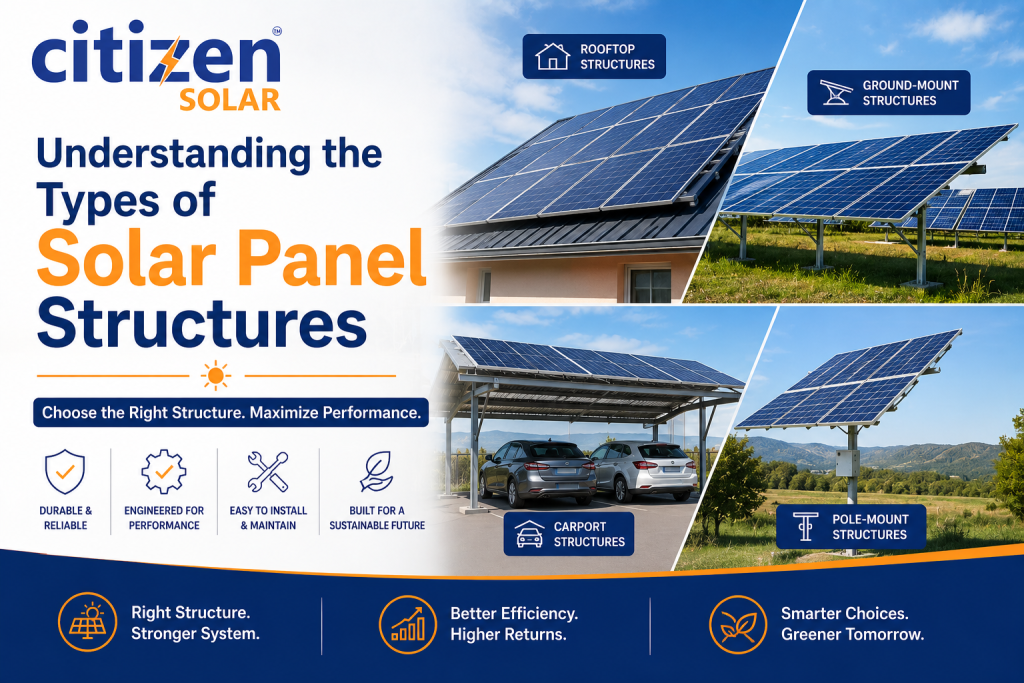
When people think about a solar installation, the first thing that comes to mind is the panel itself. The shiny modules get most of the attention. But underneath them is another important component that does a lot of work: the supporting structure.
A good structure keeps solar panels secure, maintains the required angle, and helps them handle everyday exposure to sun, rain, and wind. There isn’t only one design for every project. Homes, factories, farms and large solar plants can all require different approaches.
Choosing between solar panel structures therefore involves more than their price. Roof design, available land, weather conditions, panel orientation and long-term maintenance all deserve consideration.
In this guide, we look at the major mounting options, their benefits, pricing factors and how to select the right structure for your solar project.
What Is a Solar Panel Structure and Why Does It Matter?
A solar panel structure is the framework used to support and secure photovoltaic modules. Depending on the installation, it may be fixed to a rooftop, anchored into the ground, or mounted on poles.
A properly engineered structure should:
- Keep panels firmly secured
- Maintain the required tilt and orientation
- Distribute the weight safely
- Resist wind and other weather conditions
- Allow suitable access for cleaning and maintenance
- Remain durable throughout the system’s operating life
Materials such as aluminum and galvanized steel are commonly used because they offer a useful balance between strength, weight, and resistance to outdoor conditions.
A reliable solar mounting structure also needs to be designed around the actual site. A solution that works well on a flat commercial roof may not be suitable for a sloping residential roof or an exposed ground installation.
Types of Solar Panel Mounting Structures
Solar mounting options can be divided into three categories: rooftop structures, ground-based structures, and tracking systems.
The first one is common for homes and commercial buildings because it makes use of existing roof space. Ground installations offer more freedom where sufficient land is available. Tracking systems take a more technology-driven approach by changing panel orientation according to the sun.
Roof-Mounted Solar Panel Structures
Roof-mounted solar panels use the existing roof as the installation area, which means there is no need to sacrifice valuable ground space.
The structure used will depend on factors such as the roof material, slope, available area, panel arrangement, and structural strength of the building.
Why Rooftop Mounting Works So Well
There are a few straightforward reasons homeowners prefer this option:
- Space-saving: The roof is already there, so no additional land is normally required.
- Good use of unused space: Areas that would otherwise sit empty can contribute to electricity generation.
- Less ground disruption: There is no need for extensive excavation or ground preparation.
- Suitable for urban properties: This matters where gardens and open land are limited.
Rooftop mounting isn’t perfect for every property. Shading, poor roof orientation, or an unsuitable roof condition can change the equation.
Fixed Tilt: Simple and Reliable
Fixed tilt mounting keeps the panels at a predetermined angle. Once installed, the position remains unchanged.
The angle is selected according to the project’s location and design requirements. While the sun changes position throughout the year, a carefully chosen fixed angle can still provide effective solar generation.
Adjustable Tilt for More Flexibility
Adjustable tilt structures allow the angle of the panels to be changed when required.
This can provide greater flexibility when seasonal sun positions or specific project conditions need to be considered. Adjustment adds a little more complexity, and someone needs to make those changes when necessary.
Ground-Mounted Solar Structures
Not every property has a suitable roof. Some have plenty of open land instead.
Ground-mounted solar structures provide an alternative by supporting the panels on a framework installed directly on the ground.
This approach gives designers more freedom when deciding the panel orientation, spacing, and tilt. It is commonly considered for larger commercial, agricultural and utility-scale installations.
Why Consider a Ground Installation?
Ground mounting has several practical advantages:
- Greater layout freedom: Panels don’t have to follow a roof’s shape or slope.
- Easier access: Cleaning and maintenance can be more convenient.
- Flexible orientation: The array can be positioned to make better use of available sunlight.
- Scalable design: Additional rows can be planned where enough land is available.
Ground systems need suitable land and may require foundations, site preparation, fencing and additional cabling.
Fixed Ground Mounting
Fixed ground mounting uses a permanent support framework anchored securely into the ground.
The panels remain at a selected angle and orientation, making this a relatively simple approach for many ground installations.
The foundation is important. Soil conditions, drainage, wind exposure and the weight of the array all need to be considered before installation.
Pole Mounting
Pole-mounted solar systems raise panels above ground level using one or more vertical supports.
This can be useful where the land is uneven, space is limited, or the panels need to be elevated above vegetation and other obstacles.
The elevated position can also leave useful space underneath the array. Pole-mounted systems require careful engineering because the supporting poles and foundations need to handle the loads placed on them.
Solar Tracking Systems: When Panels Follow the Sun
Solar tracking systems use mechanical movement to change the position of the panels as the sun moves across the sky. Rather than remaining fixed, the array follows the sun to maintain a more favorable angle.
This sounds ideal, and in the right application it can be. But tracking also introduces motors, control equipment and moving components.
Single-Axis Trackers
A single-axis tracker moves the panels along one axis, commonly following the sun’s east-to-west movement during the day.
Because the movement is limited to one direction, the system is less complex than a dual-axis arrangement.
It can make sense for larger projects where increased energy production has enough financial value to justify the tracking equipment.
Dual-Axis Trackers
Dual-axis trackers can move along two axes. This lets the panels respond to the sun’s daily movement and changes in its elevation during different seasons.
More movement means more mechanical components, higher upfront costs and potentially greater maintenance requirements. For that reason, dual-axis systems tend to be considered for specialized applications rather than ordinary residential rooftops.
What Determines Solar Structure Cost?
There is no universal price because every installation is different.
Several factors can change the final cost:
- Structure Material: The material used affects strength, weight, corrosion resistance, and price. Aluminum and coated or galvanized steel are common choices.
- Mounting Method: A fixed rooftop system has a different cost profile from a ground-mounted or tracking system.
- Site Conditions: A straightforward roof may require less preparation than difficult terrain, uneven ground or a structure requiring additional reinforcement.
- Foundation Requirements: Ground-mounted systems may require concrete foundations, piles or other anchoring solutions depending on the site.
- Project Size: Larger systems require more rails, fasteners, supports and associated components.
- Wind and Weather Exposure: Areas with demanding weather conditions may require stronger engineering and additional structural support.
- Installation Complexity: Difficult roof access, unusual layouts, and specialized designs can increase labor requirements.
Don’t compare quotes on price alone. Ask what materials, engineering, installation work and warranties are included.
Why Consider Citizen Solar for Your Solar Structure Requirements?
Selecting a solar company involves looking at more than module specifications. Manufacturing capabilities, product quality, engineering support, and the company’s overall solar experience can all influence the installation.
Citizen Solar provides solar products and solutions for residential and commercial applications, with information about its manufacturing capabilities and solar offerings available through its official website.
If you’re researching solar panel manufacturers in Ahmedabad, check out Citizen Solar’s website for more information about our products, manufacturing facilities, and solar solutions.
For homeowners exploring rooftop installations, speak to our team to learn more about our residential solar rooftop solutions.
Conclusion
From rooftop frames and fixed ground systems to pole mounts and tracking technology, different solar panel structures serve different purposes. The right option depends on the property, available space, environmental conditions, panel arrangement, and budget.
A carefully selected solar mounting structure can provide the stability, positioning and durability a solar installation needs for long-term performance. Taking that decision seriously at the planning stage can save unnecessary complications later.
Citizen Solar can help you explore solar solutions designed around your property’s requirements. Whether you’re considering a residential rooftop system or a larger installation, choosing the right support structure is an important part of the process. Speak with Citizen Solar to understand your options, installation requirements, and suitable solutions. Call +91- 8000111222 and take the next step towards dependable solar power.
Frequently Asked Questions
What is a solar panel structure?
A solar panel structure is a supporting framework that securely holds photovoltaic modules. It connects panels to rooftops, ground foundations, or poles while maintaining suitable positioning.
What types of solar mounting structures are available?
Common options include rooftop mounting, fixed ground structures, pole mounting, adjustable tilt systems, and tracking solutions. The appropriate option depends on the property and installation requirements.
What’s the difference between roof-mounted and ground-mounted structures?
Roof-mounted structures attach panels to existing buildings, while ground-mounted structures use land-based foundations. Ground systems offer greater positioning and layout flexibility.
Are solar tracking systems worth the extra cost?
They can be valuable for larger projects where increased energy production justifies additional equipment and maintenance. For many homes, fixed mounting remains more practical.
What factors affect solar structure pricing?
Material, system size, mounting type, site conditions, foundation requirements, installation complexity, and local weather conditions can all influence the final structure cost.
Which structure type is best for a home installation?
A suitable rooftop structure is commonly practical for homes because it uses existing space. Roof condition, shading, orientation, and structural capacity should be assessed first.
How does the mounting structure affect energy efficiency?
The structure determines panel positioning, tilt and orientation. Proper positioning helps panels receive useful sunlight, while poor alignment or shading can reduce energy generation.
Can a mounting structure withstand heavy wind or rain?
A properly engineered structure can be designed for local environmental conditions. Appropriate materials, anchoring, foundations, and installation methods are essential for reliable long-term performance.
Do you install both roof-mounted and ground-mounted systems?
Solar providers may offer installation types depending on their services and project capabilities. The appropriate option depends on the property’s layout, available space, and requirements.
How do I know which structure is right for my property?
Consider your roof condition, available land, sunlight, weather exposure, system size and budget. A professional site assessment can help determine the most suitable option.