Category: Uncategorised

  • Which Is Better for Your Home: Off-Grid or On-Grid Solar?

    Which Is Better for Your Home: Off-Grid or On-Grid Solar?

    If you’re planning to switch to solar, one question usually comes up pretty quickly: Should you stay connected to the electricity grid or go completely independent? 

    At first, the answer seems obvious. Then you start comparing costs, battery storage, subsidies, backup needs, and long-term savings, and the decision gets more complicated than expected. The choice between off-grid or on-grid solar system depends less on trends and more on how your home actually uses power.

    This blog compares the two solar setups, explaining which one suits which situation better, helping you make an informed decision. 

    Understanding Roof Solar Power Systems

    Roof solar power is exactly what it sounds like: they’re panels on your rooftop that convert sunlight into electricity. But what happens to that electricity after it’s generated? That’s really where the two paths split. 

    In one setup, you’re tied to the local grid. In the other, you’re running your own show entirely. Both have real advantages and real tradeoffs, and honestly, neither is universally better. It just depends on where you live and what you need.

    What Is an On-Grid Solar System?

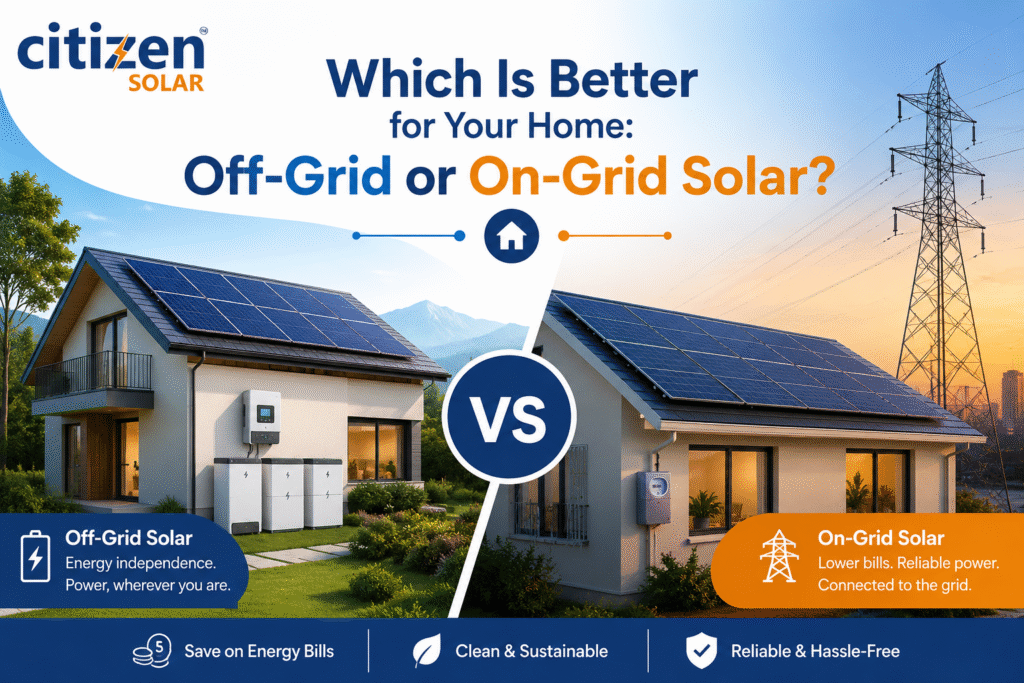
    An on-grid solar system stays connected to your local electricity grid. Your panels generate power during the day; excess is fed back to the grid through net metering, and you draw from it when your panels aren’t producing, such as at night or on overcast days. It’s a balanced setup that works particularly well when the grid supply is consistent.

    Key Benefits of On-Grid Solar

    • Lower Initial Investment: No battery storage means significantly lower upfront costs, making it a more accessible option for most households.
    • Net Metering Savings: Surplus power exported to the grid earns credits that directly reduce your future electricity bills. In states with active net metering policies, the savings can be substantial.
    • Reduced Electricity Bills: Even without exporting surplus power, generating your own electricity during daylight hours cuts what you draw from the grid and shows up clearly on your monthly statement.
    • Minimal Maintenance Requirements: The Solar Rooftop Panel setup on an on-grid system is relatively simple with no batteries, which means fewer components to monitor, service, or replace over the system’s lifetime.
    • High Efficiency Due to No Battery Loss: Power goes straight from panels to use, skipping the conversion losses that battery storage always introduces. That efficiency difference adds up over years of operation.
    • Government Subsidies and Incentives: Residential on-grid systems qualify for central government subsidies under schemes like PM Surya Ghar, meaningfully reducing the net installation cost.
    • Faster Return on Investment: Lower setup costs, combined with net metering savings, typically yield full payback within 4 to 6 years for most households.

    What Is an Off-Grid Solar System?

    An off-grid solar system runs entirely independently of the utility grid. Excess power generated during the day is stored in batteries and used at night or during extended cloudy periods. It’s self-contained, which, depending on your situation, is either a genuine luxury or an absolute necessity.

    Key Benefits of Off-Grid Solar

    • Complete Energy Independence: No external power source needed. Your panels and batteries handle everything, on your terms.
    • No Reliance on Utility Companies: Tariff hikes, grid maintenance windows, and billing disputes none of it affects you when you’re running entirely off your own system.
    • Ideal for Remote Locations: Where grid connectivity is poor, intermittent, or unavailable, off-grid is often the only practical option for reliable electricity.
    • Backup During Power Outages: Stored battery power keeps your home running when the grid fails, with no interruptions, no waiting for restoration.
    • Long-Term Energy Security: Once installed, you’re largely insulated from future electricity price increases. Your energy cost is essentially fixed.
    • Customizable Energy Storage: Battery capacity can be sized precisely to your actual consumption needs, whether that’s a few hours of backup or enough to run through two consecutive cloudy days.

    Cost Comparison: On-Grid vs Off-Grid  

    1 Kilowatt Solar Panel Price

    For on-grid systems, solar panel prices in India depend on the brand, panel quality, state, and installation details. Off-grid systems cost much more for the same capacity because of battery storage. The price gap can be large, especially with different battery types and sizes. For families on a budget, this difference is important.

    Citizen Solar and other local manufacturers have lowered component costs in recent years, making home solar more affordable. However, battery-powered systems are still much more expensive at the outset. You can contact us directly for a quote.

    Which System Is Better for Urban Homes?

    For most city dwellers with a relatively stable grid supply, moderate consumption, and a goal to reduce electricity bills, an on-grid solar system makes more practical sense. The economics work out better.

    In cities, roof solar power is often used to reduce grid power use, not replace it entirely. Net metering and subsidies both help. Plus, you don’t have to maintain a battery system that wears out over time.

    Which System Is Better for Rural or Remote Homes?

    Here’s where an off-grid solar system starts to make a lot more sense. If you’re dealing with eight-hour power cuts or living somewhere the grid barely reaches, connecting to that unreliable grid isn’t really a solution. 

    Off-grid systems give you actual, usable power regardless of what the utility company is doing. The higher cost is often worth it for consistent access to electricity for lighting, pumps, appliances, and more.

    Maintenance and Longevity

    Both systems need periodic panel cleaning and occasional inverter checks. That part is the same. 

    Off-grid systems need more attention when it comes to batteries. Lead-acid batteries require water refills and regular checks, and even lithium-ion batteries will eventually need to be replaced.

    On-grid systems don’t have batteries, so they need less maintenance over time.

    Energy Usage Considerations

    India’s PM Surya Ghar Muft Bijli Yojana gives subsidies up to ₹78,000 for on-grid home systems up to 3 kW. These subsidies are only for grid-connected setups, making on-grid systems more appealing for city homeowners.

    Off-grid systems usually don’t get these central subsidies, but some states may have their own programs.

    Roof solar power rooftop space is the other constraint. A 1 kW system needs around 80 to 100 square feet of usable, shadow-free area.

    Government Subsidy & Solar Incentives

    India’s PM Surya Ghar Muft Bijli Yojana gives subsidies up to ₹78,000 for on-grid home systems up to 3 kW. These subsidies are only for grid-connected setups, making on-grid systems more appealing for city homeowners.

    Off-grid systems usually don’t get these central subsidies, but some states may have their own programs.

    Financial Returns

    On-grid systems generally offer:

    • Faster payback, typically four to six years
    • Lower upfront investment with no battery costs
    • Ongoing bill savings through net metering
    • Access to central and state government subsidies

    Off-grid systems offer:

    • Full independence from grid electricity and future tariff increases
    • Consistent, reliable power in areas with poor or no grid supply
    • Higher upfront cost with a longer payback period
    • Long-term energy security that’s harder to put a number on

    Final Verdict: Off-Grid or On-Grid?

    There isn’t one right answer for everyone. If you live in a city or town with a steady grid supply and you want roof solar power mainly to cut your bills and use less expensive electricity, on-grid is the way to go. It’s usually more affordable, easier to maintain, and gives better financial returns.

    If you’re somewhere with unreliable grid access, or if you want full energy independence no matter the cost, off-grid is a better choice. The right system depends on your own power needs.

    Conclusion

    Both systems work, and both give you clean energy from your roof. The main differences are how the energy is used, the upfront cost, and the level of independence you get.

    For most Indian homes, on-grid solar is the practical entry point into roof solar power, offering lower costs, government support, and strong long-term savings. But if you need more reliable power than the grid can give, off-grid is worth considering.

    Want a Personalized Solar Quote?

    If you’re evaluating solar for your property, getting the system sizing and setup right from the beginning matters just as much as the panels themselves. Citizen Solar Private Limited provides high-quality solar solutions tailored for Indian homes and businesses, along with expert guidance on selecting the right system for your needs. 

    Call us to speak with our team for a customized consultation and detailed quote.

    FAQs

    What is the difference between an on-grid and an off-grid solar system?

    An on-grid system connects to the utility grid; an off-grid system runs independently on battery storage.

    Which solar system is better for homes?

    On-grid suits homes with a stable grid supply. Off-grid is better for remote areas or frequent outages.

    What is roof solar power and how does it work?

    Rooftop panels convert sunlight into electricity, either fed into the grid or stored in batteries.

    What is the average 1 kilowatt solar panel price in india?

    On-grid systems typically cost ₹45,000–₹75,000 per kW. Off-grid costs more due to battery storage.

    Why are off-grid systems more expensive?

    Battery storage adds significant upfront cost and requires eventual replacement.

    Can an on-grid system work during a power outage?

    No. Standard on-grid systems shut down automatically during outages for safety.

    Do on-grid systems allow electricity export?

    Yes, through net metering, excess power is exported and credited to your account.

    Is battery storage required for rooftop solar?

    Only for off-grid systems. On-grid setups don’t require batteries.

    How much rooftop space is needed for 1 kW?

    Around 80–100 square feet of shadow-free rooftop space.

    What maintenance do rooftop panels need?

    Periodic cleaning and inverter checks. Off-grid systems also require battery maintenance.

  • Benefits of Utilizing Solar Energy for Commercial Buildings

    Benefits of Utilizing Solar Energy for Commercial Buildings

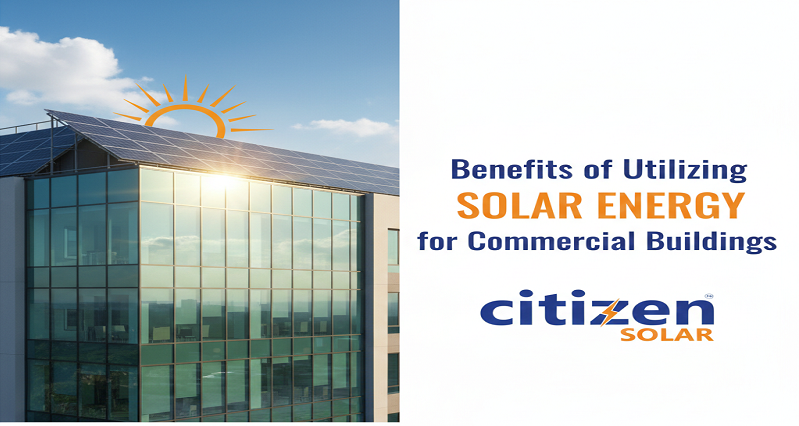
    Solar energy for commercial buildings means generating electricity on-site using photovoltaic (PV) panels, usually installed on the rooftop, parking shed, or an unused terrace area, and using that power to run your day-to-day operations.
    In simple terms, a commercial solar panel converts sunlight into usable electricity, so your building depends less on the grid during working hours (when your consumption is usually highest). 

    For Indian businesses dealing with rising tariffs, peak-hour charges, and unpredictable outages, this shift can feel like a long-term “fixed rent” for electricity.

    Key Benefits of Utilizing Solar Energy for Commercial Buildings

    Significant Reduction in Electricity Bills

    This is the first win most businesses notice. Since offices, factories, schools, hospitals, and retail spaces typically consume the most power during the day, solar generation matches your usage pattern well.

    With commercial solar in place, you can offset a big portion of your daytime consumption, lighting, HVAC, elevators, machinery, computers, refrigeration, without changing how your building operates.

    Over time, it’s not just “savings.” It’s control. You’re less exposed to annual tariff hikes and seasonal spikes.

    High Return on Investment (ROI)

    Commercial rooftops are made for scale. Once installed, solar keeps producing for decades, which is why the ROI for businesses is often stronger than residential projects.

    A well-designed system can pay back in a few years (depending on your tariff category, consumption profile, net-metering rules, and project model), and then continue generating “low-cost power” for the rest of its lifespan.

    If you’re evaluating commercial solar installation, it helps to compare the cost to what you already spend on electricity every month, and how fast that bill has been climbing.

    Government Incentives and Tax Benefits

    Commercial projects in India often benefit more through policy and tax structuring than direct subsidies. Two common levers businesses explore are:

    • Net metering/open access options (policy varies by state and DISCOM)
    • Tax benefits like accelerated depreciation for eligible entities under the Income-tax framework (business-specific; consult your CA)

    Also, MNRE’s rooftop solar programme information is publicly available and helps you understand the broader framework (even though eligibility differs by consumer category and scheme).

    Energy Independence and Reliability

    If your building loses power for even 10–20 minutes a day, the hidden costs can be huge – lost productivity, disrupted services, spoiled inventory, unhappy customers.

    With commercial solar panels, you reduce dependence on the grid supply during the day. And if you choose a hybrid design (solar + battery + grid), you can keep critical loads running even during outages.

    This is especially valuable for:

    • Hospitals and clinics
    • Cold storage and food businesses
    • IT offices and data-heavy operations
    • Manufacturing units with sensitive machinery

    Environmentally Friendly and Sustainable

    Businesses are increasingly expected to “walk the talk” on sustainability, by clients, investors, and even employees.

    Switching to commercial solar reduces your carbon footprint and supports ESG goals without sacrificing operational performance. It’s one of the few upgrades that helps your brand image and your balance sheet at the same time.

    Types of Solar Systems Suitable for Commercial Buildings

    On-Grid Solar System for Commercial Use

    This is the most common setup for urban and semi-urban commercial buildings. It connects to the grid, runs your loads in real time, and can export surplus power (where net metering is available).

    If your building has strong daytime usage, on-grid systems paired with commercial solar panels typically deliver excellent economics.

    Off-Grid Solar System for Commercial Buildings

    Off-grid systems work independently of the grid and require batteries. They’re usually chosen where grid supply is unreliable or unavailable – remote facilities, certain warehouses, rural institutions, or locations with frequent long cuts.

    The trade-off is a higher upfront cost due to batteries and a system design that prioritizes backup.

    Hybrid Solar System for Commercial Buildings

    Hybrid combines solar + grid + batteries. It’s a strong option when you want both savings and continuity, keeping essential loads (servers, emergency lighting, critical equipment) running even during outages.

    Many modern businesses prefer a hybrid because it offers flexibility without going fully off-grid.

    How Much Solar Power Does a Commercial Building Need?

    A practical way to size the system is to start with your electricity bills:

    • Total monthly units (kWh)
    • Peak demand patterns (day vs night)
    • Weekday vs weekend usage
    • Future expansion plans (more floors, more equipment, EV chargers, etc.)

    As a simple thumb rule, many commercial sites aim to offset a meaningful chunk of daytime consumption rather than “cover everything.” A good solar partner will study your load profile and propose a system size that delivers the best payback, not just the biggest plant.

    If your goal is long-term stability and savings, commercial solar power sizing should be based on real consumption data, not guesswork.

    Space Requirements for Commercial Solar Installation

    Most commercial rooftops have enough usable area, but the key is shadow-free space and structural suitability.

    Typically, 1 kW of solar may require roughly 80–100 sq. ft. of clear area (varies by panel type, mounting structure, and layout). Rooftop obstacles like water tanks, staircases, AC outdoor units, and parapet shadows can reduce effective space.

    A proper commercial solar installation plan includes:

    • Shadow analysis (season-wise)
    • Roof strength check and waterproofing considerations
    • Layout that keeps maintenance access paths
    • Safety systems (earthing, lightning arrestor, cable management)

    Applications of Solar Energy in Commercial Buildings

    Solar can support almost every common commercial load, including:

    • Lighting (indoor + outdoor + signage)
    • Air-conditioning and ventilation
    • Office equipment (computers, printers, servers)
    • Refrigeration (restaurants, supermarkets, cold rooms)
    • Elevators and pumps (with proper electrical design)
    • Industrial processes (where feasible and sized correctly)

    Many businesses also integrate solar with:

    • EV charging stations
    • Parking shed solar structures
    • Green building certifications and compliance needs

    Maintenance and Lifespan of Commercial Solar Systems

    One reason businesses love solar: maintenance is simple.

    For most sites, the main task is panel cleaning, especially in dusty zones, near highways, industrial belts, or coastal areas where salt deposition can happen. With commercial solar panels, cleaning schedules often range from weekly to monthly, depending on local conditions.

    Typical lifespan expectations:

    • Solar panels: often designed for 25+ years of generation (with gradual output degradation)
    • Inverters: may need replacement/major servicing earlier (commonly around 8–12 years, depending on quality and operating conditions)
    • Mounting structures and cables: long-lasting with proper materials and installation practices

    A strong O&M plan keeps generation stable and helps you spot issues early (loose connections, inverter faults, shading changes due to new construction, etc.).

    Choosing the Right Solar Power Company for Commercial Projects

    For commercial projects, the installer matters as much as the panels. Your system needs to be engineered for performance, safety, and approvals, not just installed quickly.

    When evaluating partners, look for:

    • Strong site survey process (shadow + structure + electrical)
    • Transparent generation estimates (and assumptions)
    • Quality components with clear warranties
    • Compliance with applicable standards and local DISCOM processes
    • Dedicated O&M support after commissioning

    If you’re looking for a reliable solar manufacturing company in India, Citizen Solar works across design, engineering, installation, and long-term support, so commercial clients get a smoother end-to-end experience. 

    For heavy-duty sites like factories and large sheds, you can also explore our dedicated solution page for Industrial Solar Panels.

    And if your business includes staff housing, guest houses, or residential rooftops within the same campus, you may also want to check solutions from trusted solar panel manufacturers in India for home installations

    Future of Solar Energy in the Commercial Sector

    Commercial solar is moving fast, both in technology and in how businesses use it.

    Some clear trends ahead:

    • More hybrid systems as battery prices improve and reliability becomes a priority
    • Smarter monitoring with AI-based alerts for faster maintenance
    • Virtual/group net metering and evolving policy models expanding access (state-wise)
    • EV charging + solar becoming a common pairing for offices, malls, and logistics hubs
    • Stronger push from brands toward greener supply chains and measurable ESG reporting

    For commercial buildings, solar is shifting from “nice-to-have” to “strategic infrastructure.”

    Conclusion

    If you manage a commercial building in India, solar is one of the few upgrades that can simultaneously reduce operating costs, improve reliability, and strengthen your sustainability story.

    Whether you’re exploring commercial solar panels for a corporate office, hospital, warehouse, or manufacturing unit, the key is getting the system size and design right, and working with a partner who understands commercial-grade engineering.

    If you want, Citizen Solar can review your recent electricity bills and rooftop details and suggest a practical system size, savings estimate, and project model that fits your building.

    FAQ’s

    What is a commercial solar energy system?

    A commercial solar energy system is a solar PV setup designed for businesses and institutions, installed on rooftops, parking sheds, or open spaces, to generate electricity for commercial loads and reduce grid dependence.

    How does solar energy benefit commercial buildings?

    It reduces electricity bills, improves energy reliability, supports sustainability goals, and can offer financial advantages through policy and tax structures (depending on your business and location).

    How much can a commercial building save by using solar energy?

    Savings depend on your tariff, consumption pattern (day vs night), system size, and net metering rules. Many businesses see strong reductions in daytime grid consumption once solar is operational.

    Is solar energy suitable for all types of commercial buildings?

    Most are suitable, provided there is sufficient shadow-free space and the roof structure can support the system. Even if rooftop space is limited, parking sheds or other structures may work.

    What is the cost of installing solar panels for commercial buildings?

    Cost varies by system size, equipment quality, installation complexity, and whether you choose CAPEX (upfront) or OPEX/RESCO models. A site survey is the best way to get an accurate estimate.

    How long does it take to recover the investment in a commercial solar system?

    Payback depends on tariffs, usage profile, system design, and policy benefits. Many commercial projects target payback within a few years, followed by long-term low-cost generation.

    Are there government subsidies or tax benefits for commercial solar installations?

    Direct subsidies are often more common in residential schemes, but commercial installations may benefit from net metering (state- or DISCOM-wise) and tax benefits such as accelerated depreciation for eligible businesses.

  • Advantages and Importance of Renewable Energy

    Advantages and Importance of Renewable Energy

    It’s no secret that the world around us is undergoing rapid transformation. Energy use sits at the heart of many global conversations: climate change, rising costs, pollution, and even politics. Every time we flip a switch, charge a phone, or drive a car, we play a role in this discussion. Increasingly, people are asking: what role can renewable energy play in building a sustainable, fair, and livable future?

    This article explores the importance of renewable energy, its advantages, types, and practical applications. We’ll also discuss challenges, opportunities, and why companies like Citizen Solar are shaping the renewable energy industry for tomorrow.

    Understanding Renewable Energy

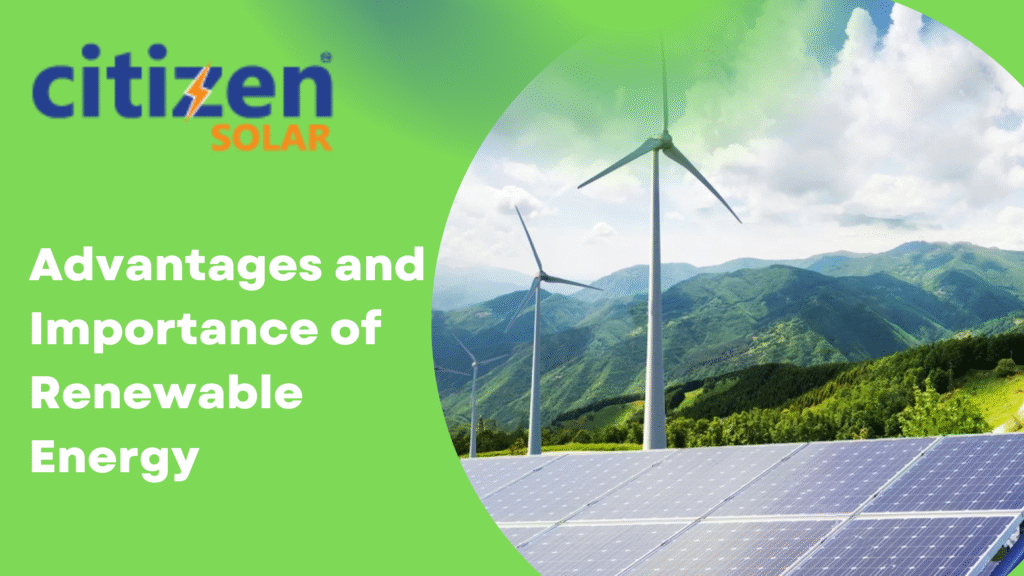
    Renewable energy comes from sources that naturally replenish themselves. Sunlight, wind, water, biomass, and geothermal heat are resources we cannot exhaust. Unlike fossil fuels, which took millions of years to form, renewable energy sources are continuously available, often right in front of us.

    The importance of renewable energy goes beyond reducing emissions. It strengthens resilience, lowers long-term costs, and gives communities more control over how they power their lives. Transitioning isn’t without challenges. Costs, technology, and infrastructure matter, but momentum is undeniable.

    Practical Uses of Renewable Energy

    You might not always notice it, but renewable energy is part of daily life more than people realize. Some of the most common examples of renewable energy include solar panels on rooftops, wind turbines powering towns, and hydropower plants supplying electricity to entire regions. Some hospitals and universities now run primarily on renewable grids, and agricultural fields rely on solar-powered irrigation systems. 

    While some applications seem futuristic, like solar highways or hydrogen-powered buses, many are purely practical. Renewables fit both large-scale systems like national grids and small personal choices, such as families installing panels on their roofs. The importance of renewable energy also lies in its role as a foundation for sustainable growth, ensuring both environmental balance and economic resilience.

    Types of Renewable Energy

    When discussing renewable energy resources, a few key types stand out:

    • Solar energy – Harnesses sunlight through photovoltaic (PV) panels or solar thermal systems.
    • Wind energy – Captures kinetic energy from wind via large turbines.
    • Hydropower – Generates energy from moving water, from small dams to massive facilities.
    • Biomass – Converts organic material into electricity, heat, or fuels.
    • Geothermal energy – Uses Earth’s internal heat for power or building heating.

    By tapping into diverse renewable energy resources, societies can secure reliable power while reducing their dependence on fossil fuels. Each type differs in terms of cost, efficiency, and feasibility, depending on the location. For instance, solar thrives in India due to abundant sunlight and falling solar panel prices in India. Hydropower is ideal in river-rich areas but not feasible everywhere.

    What Are the Benefits of Renewable Energy?

    1. Cleaner Air and Water

    Burning fossil fuels releases pollutants that cloud skies and poison waterways. Renewables produce far fewer emissions, resulting in cleaner air, water, and healthier ecosystems. The ongoing footprint is minimal compared to coal or oil. 

    1. Sustainable and Endless

    The advantages of green energy lie in its longevity. Sunlight, wind, and water cycles are endless, unlike finite fossil fuels. Future generations can rely on these resources without depletion.

    1. Cost-Effective Over Time

    Installation can be costly, but operating renewable energy systems is cheap. Sunlight and wind are free, and government incentives like subsidies on Solar panels make adoption easier for homes and businesses.

    1. Energy Independence and Security

    Countries less dependent on imported fuels face fewer price shocks and political risks. The importance of green energy extends to greater self-reliance and energy security. That independence is invaluable, especially for developing nations.

    1. Economic Growth and Job Creation

    The renewable energy industry is booming. Jobs range from manufacturing and installation to research and maintenance. Solar panel manufacturers in India are helping create thousands of new opportunities, not just in factories but across local communities.

    1. Environmental Protection

    The importance of green energy lies in its ability to protect ecosystems while creating healthier, more sustainable communities for the future. Forests, oceans, and ecosystems benefit when we reduce emissions and extraction. While not a cure-all, renewables slow environmental damage and protect biodiversity.

    1. Health Benefits

    Cleaner energy directly affects public health. Reduced air pollution means fewer respiratory issues. Studies show fewer premature deaths in areas that switch to renewables. Urban families notice improvements in areas where smog and pollution are reduced. 

    1. Technological Innovation

    Demand for renewable energy sources fuels innovation in energy storage, smart grids, hybrid systems, financing, distribution, and accessibility. 

    1. Flexibility and Scalability

    Renewables scale from mega projects like offshore wind farms to small, village-level microgrids; these systems fit a wide range of needs. This flexibility is rare in traditional energy systems.

    1. Community Empowerment

    Communities owning renewable systems feel empowered. From co-op wind turbines to shared solar storage, renewables foster cultural and technical participation.

    Utilizing Renewable Energy Across Various Sectors

    • Buildings

    Homes, offices, and schools are becoming more energy efficient with solar rooftops, green heating systems, and smart technologies. Imagine classrooms powered by solar energy during the day, running without drawing from fossil-heavy grids. These solutions not only cut costs but also reduce dependency on traditional energy sources. 

    • Industry

    Factories are among the largest energy consumers, but renewables like biomass and solar thermal systems are helping reduce emissions significantly. Many leading companies have already pledged to meet 100% renewable energy goals, showing how clean power can drive sustainable growth.

    • Agriculture

    Farms depend heavily on electricity for irrigation, machinery, and processing. Solar pumps and wind turbines not only lower energy costs but also provide reliability in remote areas. Farmers are discovering that renewables deliver consistency even when fossil fuel prices fluctuate, making agriculture more resilient.

    • Transport

    Electric vehicles powered by renewable energy make transportation cleaner. Several cities are also experimenting with biofuel buses and hydrogen-powered trains. While the transition is still underway, the progress is promising and continues to accelerate with supportive global policies.

    Advantages and Disadvantages of Renewable Energy

    It’s easy to focus only on the positives, but balance matters. Renewables offer undeniable advantages: lower emissions, long-term savings, greater energy independence, and ongoing innovation. Yet, challenges remain. Intermittency, since the sun doesn’t shine at night and the wind doesn’t always blow, and high storage costs are key obstacles. Upgrading infrastructure can also demand significant investment.

    Even so, when the pros and cons are weighed, the benefits of renewable energy clearly outweigh the drawbacks. With every technological breakthrough, the challenges shrink, bringing us closer to a future powered entirely by clean energy.

    Conclusion

    The importance of renewable energy today cannot be overstated. It is not only reducing emissions but also reshaping how we live, work, and think about energy. Cleaner air, healthier communities, and stronger economies are just some of the ripple effects. Transitioning is no longer optional. It is necessary. The more we invest in these systems now, the smoother the path will be for future generations.

    At Citizen Solar, we believe the shift to clean energy is driven by people, not just technology. Whether you’re considering solar for your home, business, or community, we’re here to help you make the transition seamless and affordable. 

    Call us today at +91-8000111222 to explore how renewable energy can power your tomorrow.

    FAQ’s

    What are the 5 benefits of renewable energy?

    Cleaner air and water, sustainable supply, cost savings, energy independence, and job creation. The benefits of renewable energy go far beyond clean power, driving innovation, reducing health risks, and building stronger economies worldwide. Many experts believe these five points summarize why renewables are the future.

    What are the important points of renewable resources?

    They’re naturally replenishing, environmentally friendly, reduce reliance on imports, and support long-term energy security. Another important point is that they help stabilize energy costs in the long run. Communities that adopt them often enjoy both economic and social resilience.

    What is the most important renewable energy?

    It depends on the location. For India, solar energy often tops the list due to its abundant sunlight and falling costs. Globally, wind and hydropower also play major roles depending on geography. Each region must prioritize what works best for its resources.

    What are the most important applications of renewable energy?

    Powering buildings, transport, agriculture, and industries are areas where switching makes a massive impact. In addition, renewables can provide off-grid solutions in rural regions, improving energy access and quality of life for millions. Other renewable energy examples include geothermal systems that heat buildings and biomass plants that generate electricity from organic waste.

    What is green energy?

    It refers to power derived from natural sources like sunlight and wind. The term emphasizes sustainability and minimal environmental harm. In simple terms, green energy aims to balance human needs with ecological preservation.

    Why should we use renewable resources?

    For cleaner air, lower costs in the long run, and reduced dependence on fossil fuels. Plus, it secures energy for future generations. They also bring innovation and help diversify national energy mixes, ensuring greater stability.

    What are the 7 main sources of renewable energy?

    Solar, wind, hydro, geothermal, biomass, ocean/tidal, and hydrogen. These sources vary in potential but together form the backbone of the global clean energy transition.

    What are the benefits of 100% renewable energy?

    Drastically reduced carbon emissions, healthier populations, improved energy security, and strong economic opportunities. Achieving 100% renewables also creates a more resilient energy grid and supports climate goals that protect future generations.